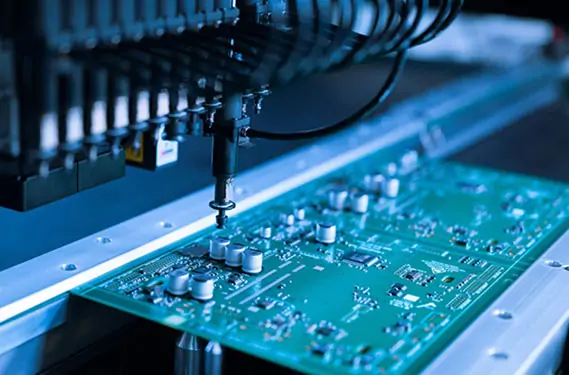
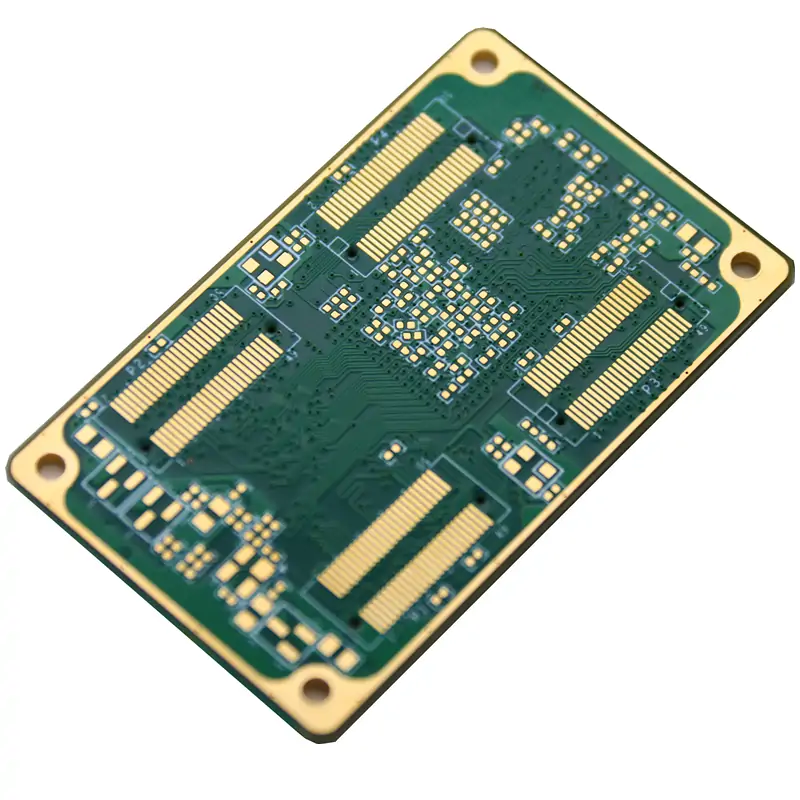
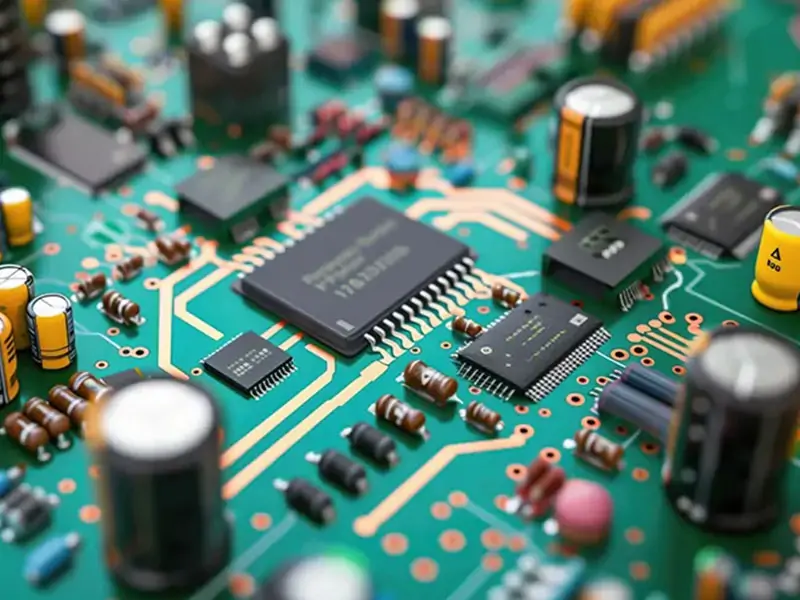
Recall a previous scenario when testing a PCB board: after meticulously soldering for hours, you power it on, only to find the PCB board unstable or completely malfunctioning. Sometimes, this isn't due to design flaws or poor solder joints, but rather contaminants remaining on the circuit board. We need to understand that throughout the entire PCB manufacturing process, due to manual and machine operations, the surface inevitably accumulates flux residue, dust, oil, or ionic contaminants.
As a professional PCBA one-stop solution provider, HongRong(shenzhen) Electronics Co.,Ltd. places great importance on PCB board cleaning. After all, these seemingly time-consuming steps are not only for the aesthetics of the PCB, but also to ensure the reliability of the circuit board, prevent corrosion, and avoid short circuits.
Next, we will guide you on how to safely and effectively clean PCB circuit boards while avoiding damage to electronic components.
------Before You Begin: The cardinal rule is to always disconnect all power sources and, if possible, remove the PCB from the device. Handle the board by its edges and consider wearing an anti-static wrist strap to prevent Electrostatic Discharge (ESD) damage, which is a leading cause of component failure during handling.
Identifying Contaminants: Know Your Enemy
Effective cleaning starts with identifying what you need to remove. Different contaminants require different approaches.
-
Dust and Dry Debris: The most common contaminant. It can impede airflow, causing overheating, and may become conductive in humid environments.
-
Flux Residue: This is the leftover material from the soldering process. While some modern fluxes are "no-clean," residues can still be sticky, attract dust, and some types can become corrosive over time, leading to electrochemical migration and circuit failure.
-
Oils and Grease: From fingerprints or mechanical contact. They can trap other contaminants and reduce the effectiveness of conformal coatings.
-
Corrosion or Oxidation: Appears as a white, green, or blue crust on metal contacts. This indicates existing damage that cleaning may only partially address
Choosing Your Cleaning Arsenal: Solutions and Tools
Selecting the right cleaning agent and tool is half the battle won. The wrong choice can damage plastic components, dissolve adhesives, or leave conductive residues.
| Tool / Solution |
Primary Use & Advantages |
Key Precautions & Notes |
| Compressed Air |
First step for removing loose dust and debris without contact. |
Hold the can upright to prevent propellant liquid from spraying onto the board. Use short bursts. |
| Soft Bristle Brushes |
Gently dislodging stubborn dust or dried flux. |
Use anti-static brushes. Avoid stiff bristles that could scratch traces or dislodge small components. |
| Lint-Free Cloths & Cotton Swabs |
Applying cleaning solutions and wiping. |
Cotton swabs are excellent for precision work around tiny components. |
| Isopropyl Alcohol (IPA) >90% |
The industry standard for dissolving flux, oils, and many organic residues. Evaporates quickly. |
Use in a well-ventilated area. High purity (e.g., 99%) minimizes water content, reducing corrosion risk. Test on plastics first. |
| Deionized / Distilled Water |
Rinsing off water-soluble flux or cleaning agents. Leaves no mineral spots. |
Never use tap water. The board must be completely dried afterwards to prevent short circuits. |
| Specialized Flux Removers |
Formulated for tough or specific types of flux residues. |
Often stronger than IPA. Check compatibility with all board materials. |
| Ultrasonic Cleaners |
Professional-grade cleaning for complex boards with hard-to-reach areas. Uses cavitation bubbles. |
Not suitable for all components! Can damage microphones, relays, or loosely bonded parts. Use with proper solution and timing. |
The Step-by-Step Cleaning Process
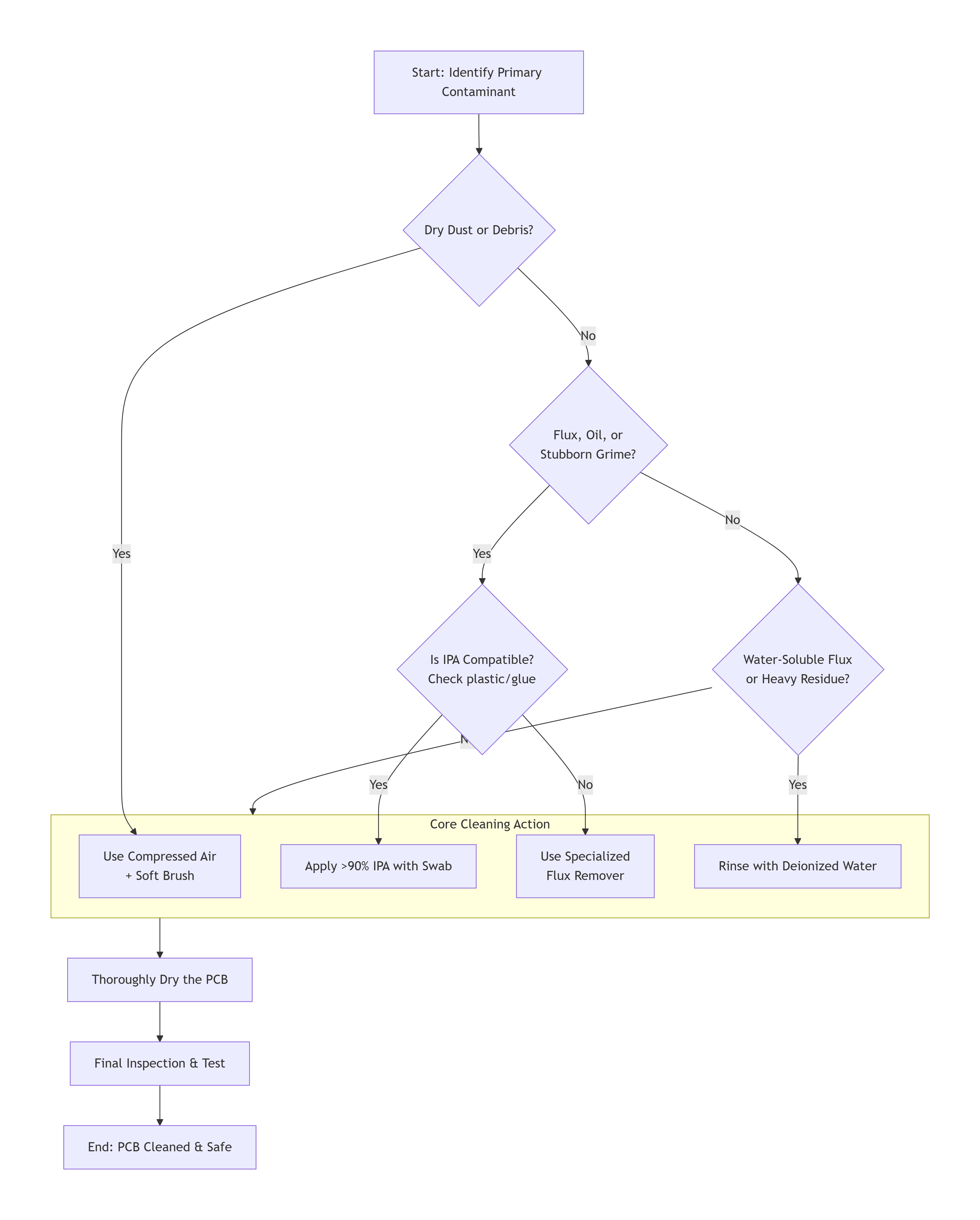
Follow this systematic approach for safe and thorough cleaning. For a visual guide, the flowchart below outlines the decision-making process based on the type of contaminant you're dealing with.
-
Initial Dry Clean: Start with compressed air to blow away loose particles. Follow with gentle brushing if needed.
-
Apply Cleaning Solution:
-
Dampen (do not soak) a lint-free cloth or cotton swab with your chosen cleaner (e.g., IPA).
-
Gently wipe the board surface, paying attention to areas around solder joints where flux resides. For stubborn residue, you may apply the solvent and let it sit for a few seconds to dissolve the grime before wiping.
-
Reach the Nooks: Use cotton swabs dipped in cleaner to carefully clean under and between tight components.
-
The Crucial Rinse (If needed): If you used a strong flux remover or an aqueous cleaner, a rinse with deionized water can help remove any cleaner residue itself.
-
Thorough Drying - NON-NEGOTIABLE: This is the most critical step to prevent corrosion and shorts.
-
First, use compressed air to blow off pooled liquid, especially from under components.
-
Then, let the board air dry completely in a warm, dry, dust-free environment for several hours, or ideally overnight.
-
For faster results, you can use a low-heat drying cabinet set around 50°C (122°F). Do not use high heat from a hair dryer.
-
Final Inspection and Test: Before reinstalling or powering, visually inspect for any remaining residue or moisture. If possible, perform a basic continuity test to check for unintended shorts.
Professional-Grade Cleaning at HongRong Electronics
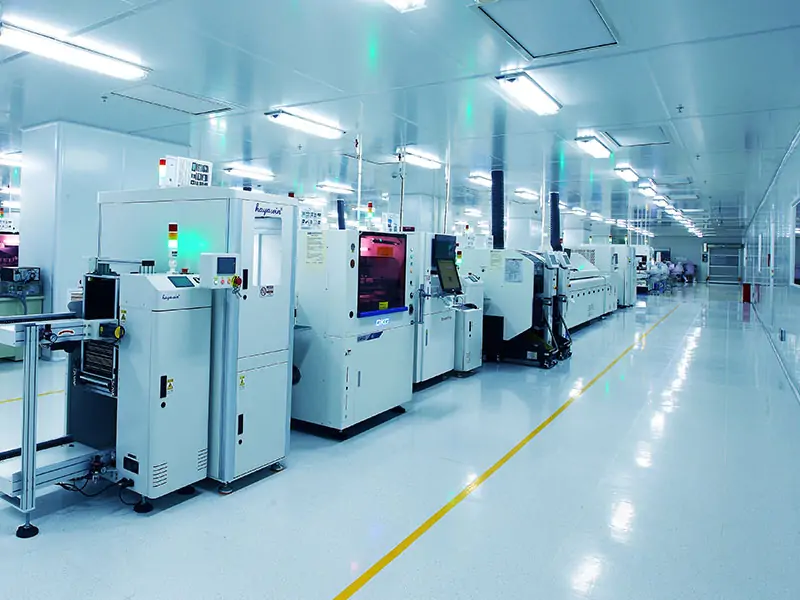
For volume production or high-reliability applications (medical, automotive, industrial control), manual cleaning is impractical and insufficient. At HongRong, cleaning is an integrated, validated step in our full turnkey PCBA process, which begins with a solid foundation in soldering techniques as discussed in our previous guide, How to Solder a PCB Circuit Board Without Errors?.
Our automated cleaning lines ensure consistency and meet stringent industry standards (e.g., IPC):
-
Automated Spray/Wash Machines: Use precisely controlled cycles of cleaning chemistry (aqueous or semi-aqueous) and deionized water rinses to clean entire assemblies, including under components.
-
Verification via ROSE Testing: We don't guess. We use Resistivity of Solvent Extract (ROSE) testers to quantitatively measure ionic contamination levels, providing data that the board meets required cleanliness standards.
-
Conformal Coating Preparation: A perfectly clean board is essential before applying protective conformal coatings. Any residue would compromise adhesion, defeating the coating's purpose.
FAQ:
Q1: Can I clean a powered PCB?
A: No. Always disconnect power before cleaning.
Q2: Does cleaning damage solder joints?
A: When done correctly, cleaning improves solder joint reliability.
Q3: Is PCB cleaning always necessary?
A: For high-reliability or dense PCBA, cleaning is strongly recommended.
Conclusion: Cleanliness is Next to Reliability
Whether you're maintaining a single prototype or managing a production run, proper PCB cleaning is a non-negotiable investment in your product's performance and lifespan. By understanding the contaminants, selecting the right tools, and following a meticulous drying process, you can effectively clean PCBs without damage.
For projects where failure is not an option, partnering with an experienced manufacturer like HongRong(shenzhen) Electronics Co.,Ltd. ensures that every board benefits from professional-grade cleaning and testing protocols. Our 20+ years of expertise in providing PCB fabrication, component sourcing, assembly, and testing guarantees that your electronic products are built for reliability from the inside out.
Have specific questions about cleaning a challenging assembly or want to learn more about our professional PCBA and cleaning services? Feel free to contact the HongRong team for a consultation.



 PCB AssemblyHRPCBA is a PCBA China manufacturer offering high-quality PCB assembly services with full-process support, from design to assembly and testing.
 PCB ManufacturingHRPCBA is a leading PCB board manufacturer offering precision PCB fabrication services. Get high-quality boards with fast turnaround and competitive pricing
 CapabilitiesDiscover HRPCBA’s robust PCB capabilities in custom PCB manufacturing services, where we transform your ideas into high-quality, functional circuit boards.